Sunday, 10 August 2025

The Driest Summer (2016)


"Plus ça change, plus c'est la même chose." Extreme weathers will always plague us, but they come and go, and we endure them.
Nine years ago, in 2016, just as a hundred-day drought was breaking for farms in southern Ontario, I wrote this article entitled The Driest Summer for Edible Toronto magazine. The cover shot featured the depleted irrigation pond built by my friends Barbara Klatt and Brian Tyson at their Brookside Farm outside Hastings.


“We never know the worth of water till the well is dry”
(Thomas Fuller, 1608 - 1661)


Our small farm has weathered the drought. This August’s heat has given way, finally, to September’s moderation, and early Fall plantings of mixed salad greens are emerging robustly where Summer’s sowings failed to materialize or thrive. Through June, July, and August, for week upon week, lashings of deep well water were unleashed on surviving plants, some evaporating on the hot surface soil and some providing life-saving relief. In our region of Peterborough, the hundred or so days from the beginning of May to August 10 were the driest here for this period since records began – in the century before last – in 1891. These extremely dry conditions covered an arc around Toronto, from the Niagara Peninsula to Price Edward County.

At Rolling Hills Organics, where we are now sixteen years certified organic, we have just three acres dedicated to market salads greens, herbs, and heirloom vegetables; the rest of our 55 acres is pasture, woodland, and wetland. We were forced by the lack of rain to switch to a much-reduced planting regime, watching helplessly as successive early plantings were sacrificed to the dry, taken over by weeds which were in turn sacrificed to the mower or tiller. With the initial weeks of no rain, it seemed counter-intuitive to till the bone-dry soil in order to plant. As the drought conditions continued, however, we found it necessary to water and plant, water and water (using our drilled well with good pressure), so as to continue to have greens for markets, albeit at reduced volume. Early in the morning, late in the afternoon, every day, we watered, for weeks on end. (We do not have a switch to flip as the bigger farms do). The heat was befuddling, but the deep-seated dry became demoralizing.


Desperate times call for desperate measures. On farms across the region wells and ponds were drained or run dry; water was pumped from rivers and lakes, canals and creeks; some farms drew from swampland; one ran a crowd-funding campaign that brought in double its target enabling three truckloads of water per week to be delivered. In the Holland Marsh – a hub of large-scale ‘conventional’ (chemicalized) food production in southern Ontario – fields were seen smeared in green algal liquid pumped from local waterways, itself the product of pesticide runoff from these same fields. Compounding the dent in bottom-line farm income, the emotional cost was steep as severe heat kicked in. Crop yields were naturally down, yet the quality of produce such as berries, tree fruits, tomatoes, grapes for wine was outstanding, the flavour intense.

The pond at Brookside Farm in Hastings that was put in at great expense for the purpose of irrigation. This year it has shrunk to such a point where farmer Barbara Klatt may need to bring in water to maintain the spring that feeds it, or else possibly lose the pond altogether.


A neighbour’s ‘conventional’ farm cut down both its glyphosate-treated soybean and corn crops, apparently as silage for the cattle. The corn crop grown across vast swathes of farmland (to be converted into government-subsidized fuel ethanol) fared poorly and reduced yield is an unavoidable consequence. Farmers Forum reports that “… in a normal crop year, prices go up. But this year’s drought corresponds with an anticipated world-record crop, putting downward pressure on prices. Corn prices hovered at $4.40 per bushel at the end of August, a long way from $8 per bushel in September of 2012.” Assuming a reduced yield of around 100 bushels per acre, this translates to ‘conventional’ farmers in corporately-controlled commodities markets receiving a paltry $440 per acre for this year’s industrial corn crop. Hay production is also low, so many livestock farmers will be forced to buy in hay as feed at inflated cost and/or sell off their animals for low return (due to a saturated market).


However, to put things in perspective: spare a thought for subsistence farmers in southern Africa. While we in parts of southern Ontario were experiencing our disturbing hundred days of drought, as Dahr Jamail reports at www.truth-out.org, “the UN's Food and Agriculture Organization warned of being in a ‘race against time’ for at least 23 million drought-stricken farmers in Africa where the southern part of the continent Africa continues to be plagued by massive droughts as climatic disruptions prevail. According to the UN, more than 60 million people worldwide, two-thirds of whom are in eastern and southern Africa, already face chronic food shortages due to ongoing droughts.” Droughts are but one part of a bigger picture, of course. As Lester R. Brown, founder of the Worldwatch Institute, has warned: “Among the environmental trends undermining our future are shrinking forests, expanding deserts, falling water tables, collapsing fisheries, disappearing species, and rising temperatures. The temperature increases bring crop-withering heat waves, more-destructive storms, more-intense droughts, more forest fires, and, of course, ice melting. We are crossing natural thresholds that we cannot see and violating deadlines that we do not recognize.”


Here in southern Ontario, as the rains return, a more normal production of Fall crops should be resumed. As organic market farmers growing many different crops, we are able to be nimble in negotiating mother nature’s curve-balls. We can write off one crop while another thrives; we can plant more, or less, water more, or less. We can wait out the storm rolling through. But sometimes, the extremes are severe shocks to the farm system, and they are increasingly systemic. Make no mistake: this challenging season was not just a wake-up call to be doused by a few gallons of water; this was a full-on jarring alarm that we could merely turn off in order to nod off to sleep again. Extended water shortages may well be a major part of our future and of farming that we had better get our heads around. We need to be vigilant in conserving water; conserving soil fertility, moisture and nutrients; conserving crop resilience and diversity. With no water, there is no food and no life. The industrial farms with their massive acreages of genetically modified glyphosated corn and soy have their own challenges as they face the long-term unsustainability of their animal feed, ethanol, industrial processing mono-crops model.


Even as the drought hit farmers hard, ground-water continued to be taken by licensed corporations for mega-profit. Regarding the extraction and bottling of water in Ontario, the Weather Network reports: “According to documents on a ministry website, Nestlé Canada has three permits, which allow the company to extract a total of 8.3 million litres of water each day for bottling. Meanwhile, Nestlé Waters Canada, a division of Nestlé Canada, has six Ontario permits allowing them to take out a further 12 million litres each day. The ministry has a map online showing all of the water-taking locations linked to active permits across the province with southern Ontario in particular, covered by a sea of blue dots. Several other companies with large water-taking permits in the province include Gold Mountain Springs at 6.1 million litres a day and Gott Enterprises at 5.8 million litres, The Canadian Press reports. For every million litres of water, Ontario charges companies $3.71 after paying a permit fee of $750 for low or medium-risk water takings, or $3,000 for those considered high risk.” This arrangement smacks of governmental insensitivity and corporate greed, particularly at a time of severe water shortage.


For all you loyal farmers market customers out there: stick with us small-scale local and organic farmers. Yes, some of us have faced challenges, we always do; but no, we are not giving up on you. We are a resilient bunch, we weather adversity well, coming back stronger. We are in this for the long term, planting more to make up for lesser yields, continuing to conserve water and build fertility. In a competitive market for consumer dollars, our prices will remain remarkably constant and out-of-sync with runaway inflation at the supermarket. Though the water table remains extremely low and sub-soils depleted of moisture, the crisp, clear days, cooler star-lit nights and, hopefully, occasional rains of Fall will revitalize our sapped plants and our weary bodies.


For now, as Helen Hunt Jackson wrote:
By all these lovely tokens
September days are here,
With summer’s best of weather,
And autumn’s best of cheer
. 


Tuesday, 25 February 2025

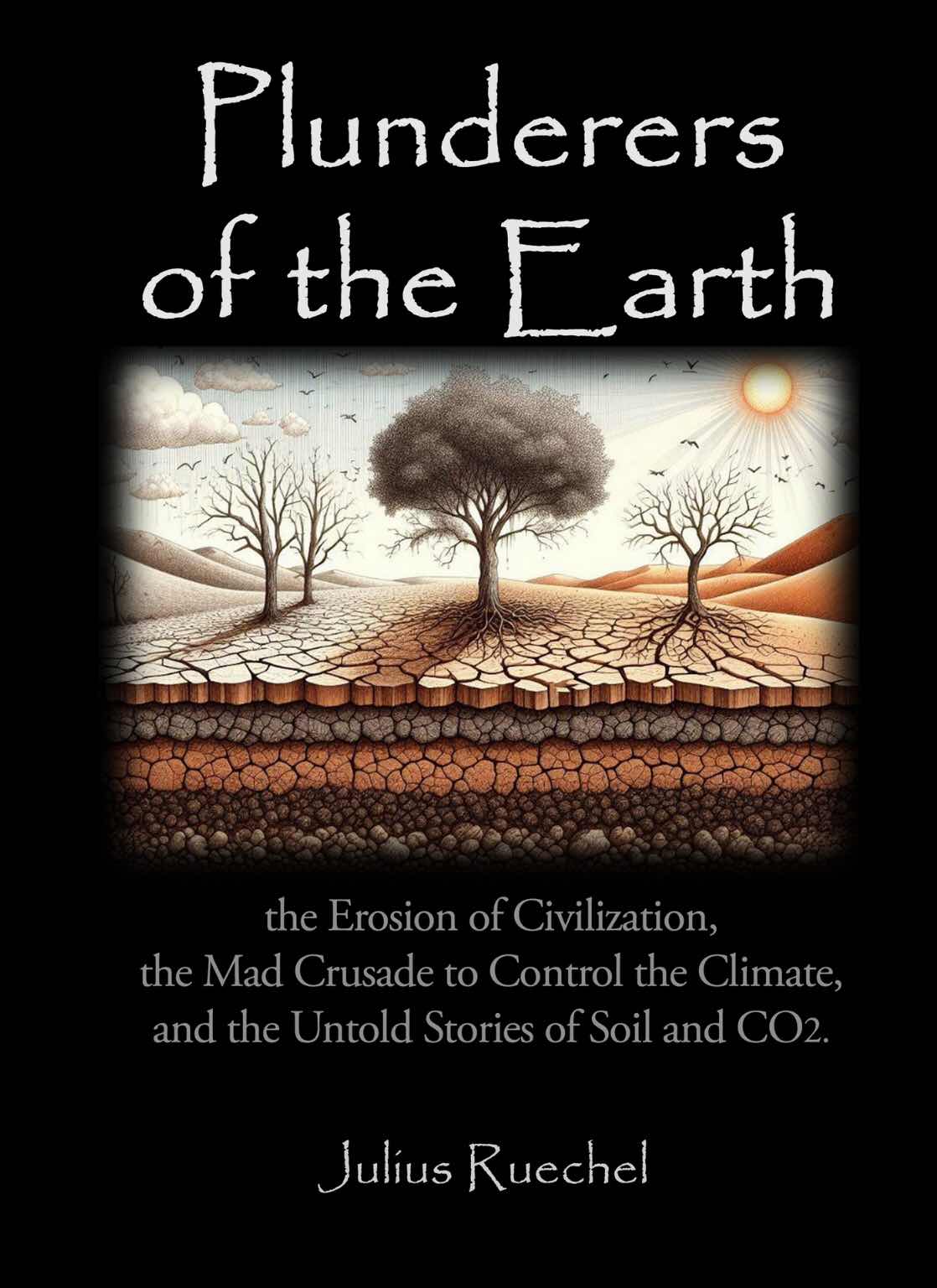
Plunderers of the Earth, by Julius Ruechel


Canadian geologist Julius Ruechel has written a groundbreaking, 680-page book called "Plunderers of the Earth, the Erosion of Civilization, the Mad Crusade to Control the Climate, and the Untold Stories of Soil and CO2". This detailed work dispels many of the more hysterical alarmist myths that have built up predicting climate calamity and planetary breakdown. It marks a short history of ever-evolving, ongoing climate change.

"In Plunderers of the Earth, Julius Ruechel tells the tale of how complex political and ecological systems unravel — often in tandem — whenever a society embraces centralized decision-making, empowers a masterful administrative state, and thereby creates perverse incentives that gradually hollow out once-thriving civilizations. But because these processes work on a different timescale from the speed at which impatient humans live their lives, few can see the slow but relentless forces eroding the foundations of civilization, and fewer still recognize the implications.

No academic discipline is a better example of the corrupting influence of politics than the field of climate science. The crusade against carbon dioxide that has emerged from the toxic marriage between science, politics, and corporate interests not only serves as the “noble lie” upon which to build a new global social order — and to grease the wheels of a wholly artificial $5 trillion (and growing) “green” global economy — but in an echo of the destructive forces set in motion in the lead-up to the Dust Bowl of the 1930s by another now-discredited climate theory (“the rain follows the plow”), today’s erroneous climate theory is once again preventing us from recognizing an altogether different and very real ecological story unfolding right beneath our feet that has gone largely unnoticed even as our misguided climate policies accelerate that ecological crisis and block its solutions."

In his Substack post, Sep 6, 2024, Julius Ruechel explained:

Most of the lies hollowing out our world contain some distorted kernel of truth — they often only become lies as they are stripped of their broader context and bent to fit a dominant narrative. As ancient Greek philosopher Solon once said, “A half truth is the worst of all lies because it can be defended in partiality.” ....

Is CO2 a greenhouse gas? Yes.... but its effect is so small that it's essentially inconsequential to the climate. The first few parts per million helped warm the Earth (a tiny bit) in the early days of our planet's 4.5-billion-year history. But as is so often the case wherever the "Law of Diminishing Returns" comes into play, after the initial bump produced by the first few ppm, the ability to absorb additional infrared radiation from the Sun drops off so fast as to be meaningless... The first oceans formed on our planet around 3.8 billion years ago. Ever since then, vast quantities of water are continually evaporating from the oceans to accumulate in our atmosphere as water vapour. And that water vapour absorbs the same wavelengths of infrared radiation as CO2 does. Thanks to that overlap in wavelengths, the greenhouse effect from CO2 is utterly irrelevant as long as there's water vapour in the atmosphere....

A great example to illustrate the importance of water vapour even as it exposes the irrelevance of CO2 comes from comparing the climate in humid Florida to that of the dry Sahara Desert, which are at roughly the same latitude and which both have the same amount of CO2 in the air. On those hot, humid summer nights in Florida, sweltering nighttime temperatures barely dip as water vapour traps heat that has built up over the course of the day. Meanwhile, with very little moisture in the air above the dry Sahara to insulate the ground from the baking Sun, daytime temperatures soar far above the hottest temperatures seen in Florida during the daytime, only to immediately plunge to well below freezing as soon as the Sun goes down. Without enough water vapour in the air, the ground is exposed to the full force of the Sun during the daytime and then, as night falls, the day's accumulated heat quickly escapes back out into space without water vapour to trap that heat. Water vapour matters. CO2 does not....

The idea that "carbon dioxide is the control knob on the climate" is a colossal public deception. In reality, what drives climate on both short- and long-term timeframes is a dizzyingly complex and dynamic mix of forces: solar cycles, ocean currents, water vapour, wobbles in our planet's orbit, cyclical changes in cloud cover, continental drift, cosmic radiation, and so on, all of which are covered in detail in my new book as I piece together the fascinating puzzle that shapes our ever-changing climate. Carbon dioxide is all but irrelevant within that dynamic mix. However, what sets carbon dioxide apart is that, unlike all these other forces, shining a big spotlight on CO2 made it politically useful.
After the oil crisis of the 1970s, followed by the coal miners' strikes in Britain in the 1980s, politicians (beginning with Margaret Thatcher) began pouring vast amounts of public funds into climate research (with a specific focus on highlighting the greenhouse effect of carbon dioxide) as a deliberate strategy to push society away from fossil fuels and towards nuclear power — the primary goal of this push was to break the dependency on colluding Middle Eastern oil suppliers and on socialist-sympathizing labour unions in the British coal mining industry. What began as a convenient narrative to shepherd society towards one deceptive political purpose has since mutated into something else altogether as countless others have found new ways to adapt that narrative to suit their own agendas... and to profit from it both politically and financially. Just because an idea isn't true doesn't mean it isn't useful to a lot of people. Nor does it necessarily mean that Thatcher and her peers knew they were promoting baloney — it is all too human to glom onto and champion any idea that confirms our biases if those ideas seem to take us towards our goals....

Is there a link between CO2 and temperature? Again, yes. But in that relationship, temperature is the horse while CO2 is the cart. The cart does not control the direction of the horse. CO2 dissolves in water, but its solubility decreases as water temperature increases.... What this means is that as oceans warm up after an ice age, they necessarily begin to degas CO2 in the same way that CO2 bubbles out of a soda as the soda warms up. Likewise, as global temperatures cool, the oceans cool in lockstep and begin to absorb CO2 back out of the atmosphere. CO2 follows temperature — basic chemistry makes it impossible to be the other way round....

Thanks to this relationship between CO2 solubility and water temperature, we can see over the past few million years that atmospheric CO2 decreases to around 180 ppm during ice ages, and then rises back up to around 280 ppm as oceans warm up during warm interglacial periods. CO2 lags temperature by around 800 years because it takes that long for deeper levels of the ocean to warm up after the climate warms. Warming or cooling that much "soda" takes time....

Is human activity changing our climate? Again, yes, but not in the way that it is popularly portrayed — those changes have nothing to do with fossil fuel emissions but have everything to do with how our activities are impacting local water cycles.
Two of the most important ways in which humans change their local climates are through:
Deforestation: As forests are cut down, rainfall decreases, which causes local climates to get drier. The most obvious example of this phenomenon is the well-known story of what happens to the local climate after the Amazonian rainforest is cleared to make way for soybean plantations, but the drying of local climates happens everywhere that forests are cut down. 
For example, contrary to Al Gore's claims, Mt. Kilimanjaro's glaciers are not shrinking because the global climate has gotten warmer, but because the local climate got drier as locals deforested the perimeter of the mountain. Without lush forests to shield the soil and pump water vapour into the atmosphere through evapotranspiration, the region got drier, less rain and snow fell on the mountain, and the increasingly dry air increased sublimation rates as the dry air turned ice on the mountain back into water vapour. And, to make matters worse, as the air got drier, there was less water vapour in the air to shield the icy mountaintop from the full intensity of the Sun, just like in my earlier example from the Sahara.
Once again, the important part of the story is not temperature, it's aridity — water vapour. All around the world, there is a direct link between deforestation, aridification, and desertification. By destroying at least one third of the planet's historic forests over the past few centuries, we have completely reshaped countless local climates.
Soil erosion and humus losses: Sod protects soil from evaporation. And carbon (humus) in the soil acts like a sponge to capture and absorb moisture during a rainfall. Thus, any human activity that strips soil of its vegetative cover and erodes and/or oxidizes carbon in the soil will cause soil to get drier and the plants growing on it to become more vulnerable to water shortages. In other words, soil erosion makes the local climate more vulnerable to drought even if rainfall stays the same.
All over the world, our impact on the land is fueling colossal rates of soil erosion, which lead directly to desertification. According to UN estimates, we are losing around 24 billion tons of fertile cropland soil to erosion every year. Over 1.5 billion hectares of formerly productive land have already been lost to desertification... and that number is growing by an additional 12 million hectares per year! But contrary to popular claims, this desertification is not caused by CO2 — it's purely the result of how we are (mis)managing the land, which is causing the land to dry out.
As for those 1.2 billion climate refugees that the United Nations predicts will be migrating north to escape a warming climate by 2050... although many really are fleeing rapidly deteriorating local climates, in reality they are fleeing desertification caused by local deforestation and local soil erosion, not changes to the global climate. But would borders be flung wide open to receive them if it was widely recognized that they were fleeing local land management problems instead of the alleged consequences of CO2 belching out of SUVs in rich countries?...

By blaming CO2, we are ensuring that the true underlying causes of this slow-rolling ecological collapse are completely misunderstood. By consequence, the solutions imposed by both governments and local land managers are destined to be completely ineffective at fixing the problems (or even make the problems worse) because they fail to address the root causes.
Not only is "green colonialism" undermining the ability of developing countries to solve their own problems as Western institutions dictate to poor countries how they should (and shouldn't) develop their economies, but the CO2-obsessed bureaucratic institutions of the neo-liberal West are also busily demonizing and even banning all of the most important yet deeply misunderstood tools that land managers all over the world have at their disposal to reverse the processes of soil erosion and desertification — such as grazing livestock, low-intensity controlled wildfires, and a host of other strategies that are essential to create and sustain fertile drought-resistant soils...

Anyone familiar with the geologic record is well aware that past climates follow a simple rule of thumb: hot and humid, cold and dry. But why? Intuitively we think that deserts should expand as it gets hotter, but the opposite is true. Why do deserts expand whenever the climate cools, while rainforests and lush vegetation expand whenever the global climate warms?

The simple explanation for this paradox is that more than 70% of the planet's surface is covered by water. Evaporation increases over the oceans as the planet warms, which increases global humidity levels, which in turn increases rainfall over land as trade winds push that extra moisture over the continents.  Peer-reviewed research referenced in my book has shown that a mere "10% increase in humidity levels increases rainfall by two to three times." 
And so, paradoxically, despite the fact that temperatures and thus global humidity and rainfall are increasing, deforestation and soil erosion are nevertheless causing many local regions to suffer from drought, falling stream levels, and declining aquifers. Our destructive impact on our local ecosystems has damaged the moisture absorbing capabilities of our soils, increased runoff rates as the extra rainfall washes away as floods instead of absorbing into the soil, and increased soil evaporation rates by removing the sod and vegetative cover that once shielded the soil from the Sun. 
Even here in British Columbia, there's a direct link, described in detail in the book, between soil mismanagement, drought-stressed trees, pine beetle infestations, and the dangerous high-intensity wildfires that have plagued so many communities in Western Canada in recent years. The underlying causes have nothing to do with CO2 or global warming but have everything to do with how we are mismanaging our fields, grasslands, and forests. In effect, we are manufacturing drought (and suffering its consequences) despite an overall trend of increasing precipitation.....

We have been fortunate over the past century to enjoy one of the most favourable climatic periods in history. But the past century is not the norm. The droughts of the last century have been nothingburgers compared to the vicious droughts that routinely happened during the long dry phases of our ever-changing cyclical climate. 
If the soil erosion we have caused over the past century has been so severe that it is causing streams and aquifers to decline during periods of increasing rainfall, imagine what will happen when the climate really does turn drier during the next dry cycle?...

Megadroughts are not existential threats to ecosystems as long as soils are healthy. Plant growth decreases and animal populations shrink as rainfall levels decline, but the geological record clearly shows that these megadroughts did not trigger full-scale ecosystem collapses before humans came along because the plants and animals in these arid regions evolved strategies to cope with these natural long-term climate cycles. Cyclical climate variations only become an existential threat to an ecosystem when you remove the sod, erode the soils, remove the animals that formerly kept the sod and soil healthy, and exhaust the carbon (humus) in the soil, thus robbing the ecosystem of all its natural defences to withstand these long-duration cyclical changes in temperature and rainfall.
Decades of deforestation and/or soil erosion have made our local ecosystems increasingly brittle, yet that increased brittleness remains invisible during periods of abundant rainfall. The increased brittleness is only exposed when the next dry phase of the cyclical climate begins, and the ecosystem suddenly and catastrophically begins to fall apart. 
For example, in the late 1800s and early 1900s, settlers busted the sod of the Great Plains with their plows. Everything was fine and everyone enjoyed bountiful crops until the 1930s when the climate shifted towards a natural dry phase caused by cyclical changes in ocean currents off the Pacific Coast (the Pacific Decadal Oscillation, which runs on a 50-year cycle — 20 to 30 wet years followed by 20 to 30 dry years). The denuded soils, stripped of their protective sod and depleted by decades of intensive cultivation, were left utterly defenseless against the dry conditions, and so the entire Great Plains ecosystem suddenly collapsed in the greatest man-made ecological disaster in North American history. Entire soil horizons were carried away as dry winds swept across the plains from the West even as plagues of locusts and jackrabbits consumed any specs of greenery that hadn't already been turned to dust by the dry winds....

While deforestation, soil erosion, and desertification are all bad news stories, rising CO2 is beneficial to plants as an essential fertilizer element — many commercial greenhouses even pump CO2 into their greenhouses to raise CO2 to more than double current atmospheric CO2 levels in order to boost plant growth. Rising atmospheric CO2 also helps plants conserve moisture because they don't have to open their pores as widely to absorb the CO2 they need from the atmosphere. 
But does all this mean that rising CO2 is a good news story can be disregarded — a fortunate beneficial side-effect of our use of fossil fuels? Once again, there’s so much more to the story. While increasing amounts of CO2 in the atmosphere are undeniably beneficial to plants, once you understand the real reasons why atmospheric CO2 is rising, it soon becomes apparent that it's not a good news story at all. 
The "consensus narrative" alleges that most (78%) of CO2 comes from fossil fuel emissions. But the economic slowdown caused by Covid lockdowns punched a giant hole in that narrative. As NASA reported in 2021, "the most surprising result is that while carbon dioxide (CO2) emissions fell by 5.4% in 2020, the amount of CO2 in the atmosphere continued to grow at about the same rate as in preceding years." This isn't what should have happened in a straightforward case of cause-and-effect. Whenever there's a loose thread in a story that everyone assumes to be an undeniable fact, you have to test your assumptions by giving that loose thread a good pull to see what falls out.
A further controversy erupted in 2022 when a study by Skrable et al. looked at carbon isotopes in the atmosphere (C-12 vs C-14) to try to directly measure (rather than assuming) what proportion of the atmospheric gas mix comes from fossil fuels. Their results were nothing less than heresy — if the authors of the study had lived in the year 1600, they most assuredly would have been burned at the stake along with Giordano Bruno for his then-heretical claim that the Earth orbits the Sun. Skrable et al found that only 12% of the CO2 in our current atmosphere can be traced to fossil fuel emissions. 
12%, not 78%!
But is that a plausible finding? If not from fossil fuel emissions, then where does it come from and why is CO2 building up in our atmosphere instead of topping out at around 280 ppm like it did during previous warm interglacial periods?
As you'll discover when you dive into my new book, pulling on these loose threads led me to stumble across the most important scientific and political detective story of our century. What emerged as the many pieces of this story came together is a complex tale about soil, about global biomass, about land management, about ecological crises, and ultimately about the perverse incentives created by central planning, which not only hollow out civilization but also the ecosystems upon which civilization is built. 

“When we try to pick out anything by itself, we find it hitched to everything else in the universe.” ― John Muir






Thursday, 2 January 2025

A Change in the Weather


Fifty Years in the Making
We have come a long way in fifty years - from one extreme to the other. And we still don't know where we are headed. Is it net zero or 500 ppm of CO2?
The weathermen say it is all or nothing. Change or collapse. A return to pre-industry or calamity. Phase out fossil fuels or bake on a boiling planet. Transition to net zero or it is the end of humanity. Bet the farm or bust. But, if we do suck up the coming stringency for all us plebs, what will actually change? Will CO2 parts per million miraculously revert to the lauded 280? What difference will that make to the weather? Will the droughts and floods and heat domes and extreme weathers miraculously halt? 

Climate Deceptions
Computer modelling has a lot to answer for - a lot of obfuscation, a lot of false leads, and a lot of fear-and doom-mongering.

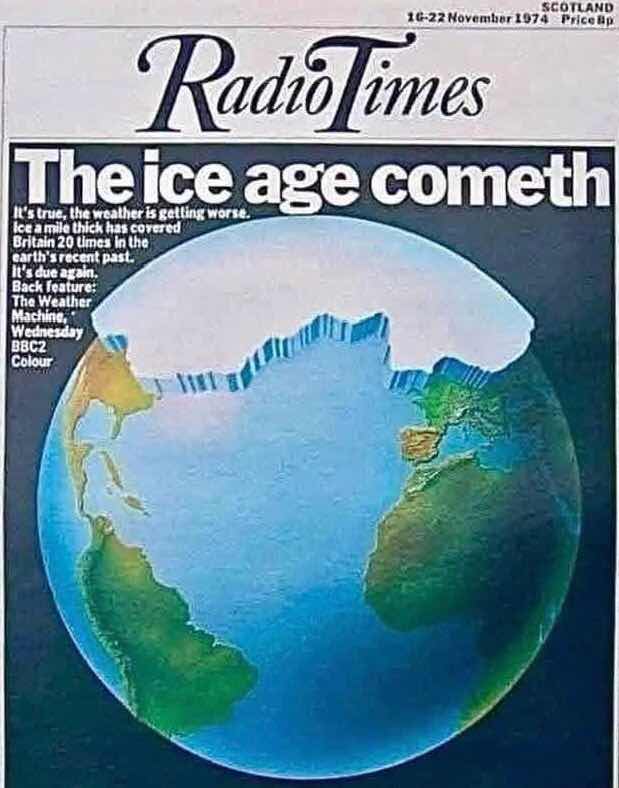
The BBC announced The ice age cometh on the cover of Radio Times, 16 - 22 November, 1974 edition (see image above)

The April 28, 1975 issue of Newsweek soon after presented a one-page feature authored by Peter Gwynne in its 'Science' section entitled The Cooling World. It wrote: " The central fact is that after three quarters of a cenury of extraordinarily mild temperatures, the earth's climate seems to be cooling down. Meteorologists disagree about the cause and effect of the cooling trend, as well as over its specific impact on local weather conditions. But they are almost unanimous in the view that the trend will reduce agricultural productivity for the rest of the century. If the climate change is as profound as some of the pessimists fear, the resulting famines could be catastrophic."


National Geographic then published a lengthy feature about climate change in its November 1976 edition, right at the height of the 1970s global cooling scare.
From the seminal work Plunderers of the Earth by Canadian geologist Julius Ruechel, published in 2024:
"There are two take-home messages from National Geographic’s 1976 four charts, which are important in order to understand...
1. Climate is not stable, but rather it is driven by a multitude of powerful cyclical forces acting over both long- and shorter-time scales, which are constantly tugging climate in one direction or another.  
2. The heat of the 1930s was much warmer than both the cold climate of 1880s (just after the world came out of the Little Ice Age) and the cool climate of the 1970s (when scientists were warning us about the next ice age).
And yet, in 2023 we were told that global temperatures were allegedly the hottest in more than 100,000 years......"


Thirty years later, An Inconvenient Truth morphed into serial inconvenient untruths. Way back then, in 2006 (just eighteen years ago!) we heard from Al Gore that:
- Africa’s tallest peak, Mount Kilimanjaro, will be snow-free ‘within the decade'
- temperature rise from increases in man-made carbon dioxide emissions are ‘uninterrupted and intensifying'
- heatwaves will become more common, like the one that killed 35,000 people across Europe in 2003
- within the next 50 to 70 years, polar ice could be completely gone. (He later said the ice would be gone by 2013, which was even more ridiculous.) 
- Sea levels could rise twenty feet
- Unless the world dramatically reduces greenhouse gases, we will hit a “point of no return (in a mere ten years).
- depictions of San Francisco and Florida disappearing under the rising sea level played up drama at the expense of accuracy.

In the ensuing eighteen years, oil and gas have continued to be extracted, unabated. The sky has not fallen in, though global average temperatures continue their incremental rise in many places but certainly not all, in the oceans and on land. This rise has not accelerated. Sea levels have risen a millimetre or more but not drastically. And the peak of Mount Kilimanjaro continues to be snow-covered. Any mitigation measures have failed to halt the rise of CO2 parts per million, the new demon of 'anthropogenic global warming'. Weather modification and solar geo-engineering boondoggles continue to be taboo to exposure by the military, governments, and the fawning, uninquisitive media.

The mechanics of the climate are complex and subject to regional and local variances.
CO2 is a minor consideration (400 parts per million or 0.004% of the Earth's atmosphere) compared to water vapour at 70%. Desertification, deforestation, loss of soils, loss of biodiversity on land and in oceans, droughts, floods and, yes, warming weathers emerging here and there are far greater contributors, brought on as they are by natural cycles and intensifying environmental mismanagement, geo-engineering, weather manipulation.

“The science shows us that fears of a climate apocalypse are unfounded. Global warming is real, but it is not the end of the world. It is a manageable problem. Yet, we now live in a world where almost half the population believes climate change will extinguish humanity. This has profoundly altered the political reality. It makes us double down on poor climate policies. It makes us increasingly ignore all other challenges, from pandemics and food shortages to political strife and conflicts, or subsume them under the banner of climate change… If we don’t say stop, the current, false climate alarm, despite its good intentions, is likely to leave the world much worse off than it could be… We need to dial back on the panic, look at the science, face the economics, and address the issue rationally.” 
― Bjorn Lomborg

Wednesday, 10 April 2024

Breathing


Man has travelled to outer Space
and plumbed the deep blue sea,
but I am happiest here on land,
breathing strong and full and free.


Monday, 15 January 2024

Challenging The Ecomodernist Dystopia


From Chapter IX of Colin Todhunter's profound exploration of Sickening Profits, The Global Food System's Poisoned Food & Toxic Wealth:

"A cartel of seed, chemical and food manufacturing and processing companies with total control over the food production and supply chain in India and throughout the globe.

And it will be total. As previously mentioned, big global biotech corporations like Bayer and Corteva are extensively patenting plants. Such patents on plants would restrict farmers’ access to seeds and impede breeders from developing new plants as both would have to ask for consent and pay fees to the biotech companies.

This is ‘ecomodernism’ in action. It goes hand-in-hand with elite interests who will rake in enormous profit as they seek to control every aspect of food, farming and, indeed, life.

In India, we see various tactics at work to bring this about — the deliberate strategy to make smallholder farming financially nonviable, attempts to dismantle public distribution systems and minimum support prices, the relentless drive to get GM food crops cultivated, the data-gathering Agristack initiative overseen by Microsoft and the increasing capture of the retail sector by Walmart, Amazon, Facebook and Google (all described in the 2022 e-book Food, Dependency and Dispossession: Resisting the New World Order).

The Indian government is trying to establish a system of ‘conclusive titling’ of all land in the country, so that ownership can be identified and land can then be bought or taken away. As farmers lose access to land or can be identified as legal owners, predatory institutional investors and large agribusinesses will buy up and amalgamate holdings, facilitating the further roll out of industrial agriculture.

In this brave new world, notions of food sovereignty and seed sovereignty have no place. A case of you will own nothing, be happy and eat a diet of genetically and biochemically engineered ‘food’ — junk food to complement existing junk food that claims hundreds of thousands of lives across the globe annually.

‘Food’ courtesy of giant ‘fermentation’ vats and farms manned by driverless machines, monitored by drones and doused with chemicals to produce crops from patented GM seeds for industrial ‘biomatter’ to be engineered, processed and constituted into something edible. An AI-driven, corporate-controlled, ‘solyent green’ dystopia where the marketplace has been eradicated and a handful of companies and e-commerce platforms control the global economy.

However, none of this is a given. The farmers’ protest in India led to the repeal of corporate-backed legislation that would have accelerated the trends described above, and, as Vandana Shiva notes, more than 150 community seed banks have been established in the country — local seeds, adapted to local cultures which provide better nutrition and are more resilient to climate change.

Shiva says:

“At the Navdanya Farm and Earth University, we have trained more than one million farmers who now practice organic agriculture based on biodiversity and without the use of synthetic chemicals. The shift from globalisation driven by multinational corporations to a progressive localisation of our economies has become an ecological and social imperative, essential for food sovereignty.”

She concludes:

“Food sovereignty means feeding ourselves real, genuine, biodiverse food and freeing ourselves from the false promises of artificial food.”

Of course, the agri biotech sector are dismissive of the ability of organic agriculture to feed the world and of a world described by Shiva, which rejects corporate dominance and new forms of imperialism.

Their anti-organic, pro-synthetic food stance should be seen for what it is — fearmongering (the world will starve without GM agriculture), pro-corporate ideology and an adherence to centralised power, which flies in the face of firm evidence that indicates organic supported by an appropriate policy framework is more than capable of addressing the challenges ahead."


Wednesday, 8 November 2023

Letter to the Children of Gaza


"Dear child. 
It is past midnight. I am flying at hundreds of miles an hour in the darkness, thousands of feet over the Atlantic Ocean. I am traveling to Egypt. I will go to the border of Gaza at Rafah. I go because of you....
We have failed you. This is the awful guilt we carry. We tried. But we did not try hard enough. We will go to Rafah.  Many of us. Reporters. We will stand outside the border with Gaza in protest. We will write and film. This is what we do. It is not much. But it is something. We will tell your story again. 
Maybe it will be enough to earn the right to ask for your forgiveness."

Thursday, 27 July 2023

Heading Towards Existential Chaos


Fishers and farmers around the world will attest to the fact that weather patterns are topsy-turvy. Unpredictable and shifted seasons, together with extreme, calamitous storms, floods, droughts, crop die-offs and failures have upset their traditional way of farming and harvesting food. Glaciers and ice-sheet melt have accelerated and industrial deforestation and soil degradation continues apace.

It seems that weather events - wildfires, floods, droughts, hurricanes, heat waves and domes - are becoming more extreme and more frequent. Is this all in our imagination? Is it all planned and engineered? What else are we to make of weather warfare via geo-engineering; poisoned skies; dimming of the sun; solar radiation management; heavy metals, nano-particles, polymers, graphene, aluminum spraying; atmospheric high pressure heat domes; named heat waves; static energy build-up; dry lightning; forest fires used as a military weapon?

Grand technological plans to control our climate are now acknowledged by governments to be afoot and have been for a decade and a half. Like plans to control pandemics, public health, the industrial food system, Big Agriculture, and introduce Central Banking Digital Currency, they have been in development - through such nefarious over-reaching organizations as the World Health Organization, the World Economic Forum, the World Bank, the International Monetary Fund, the Gates Foundation, and implemented by trade blocs and nations unified by the United Nations. When you have gained control of public health, food, farming, banking, commerce, government, the climate, and personal freedoms, you have laid the groundwork for authoritarian control of the entire populace. For what purpose? So that a small coterie of the super-empowered in their pampered enclaves can live out fantasies by suppressing and controlling a mass of humanity that has been rendered dispensable?To cover their asses as their debt-ballooning fiscal policies create runaway inflation and soaring economic hardship for the masses? Such short-term, egotistical thinking cannot be sustained and must, like everything else, collapse under its own dead weight.

Why the single-minded obsession with carbon and decarbonization? This is misguided and delusional and has only come to bear because of its capacity to be monetized. Carbon credits, carbon taxes, carbon sequestration. Raytheon, Lockheed Martin, Blackrock, Pfizer, Moderna and more are on a roll.
Much more vital are efforts to conserve water, nature, soils, trees, wetlands, grasslands, and biodiversity; regenerate land, forests, rivers, lakes and oceans; and detoxify polluted air, water, soils, bodies, minds, spirits. The climate and human health will regulate themselves by swinging back into balance and harmony if only natural processes are left to their own all-powerful devices. 

As Charles Eisenstein noted in his brilliant essay "How The Environmentalist Movement Can Find Its Way Again": 
"... we have made a scientific, strategic, rhetorical, and political error by reducing the ecological crisis to climate, and the climate crisis to carbon. Earth is best understood as a living being with a complex physiology, whose health depends on the health of her constituent organs. Her organs are the forests, the wetlands, the grasslands, the estuaries, the reefs, the apex predators, the keystone species, the soil, the insects, and indeed every intact ecosystem and every species on earth. If we continue to degrade them, drain them, cut them, poison them, pave them, and kill them, earth will die a death of a million cuts. She will die of organ failure—regardless of the levels of greenhouse gases.
That is why, if I may be so bold as to make a prediction, that we will see increasingly dramatic derangement of weather patterns over the next few years. Indeed it has already begun. Floods, droughts, fires, anomalous heat, cold, wet, and dry at the wrong time of year will intensify - even in the absence of significant global warming. Such is already the case. I’m sure you’ve noticed. The weather has been weird the last few years; in some places, devastatingly so. Yet, global temperatures (according to the most reliable measure, satellite measurements of the lower troposphere) are about what they were in 2016. The overall trend since measurements began is definitely a warming trend (about 0.13 degrees per decade), but it has not been accelerating.
Herein lies the strategic error. Having hitched the environmental wagon to the global warming horse, what happens if the horse stops running? It won’t mean that our environmental problems will have been solved. It won’t mean the crisis has been averted, if temperatures stop rising. That is because the core of the crisis is not warming, it is ecocide—the killing of ecosystems, the killing of life...."
"I am afraid that we can continue to lay waste to the living earth, indefinitely, ending up on a concrete world, so chronically ill physically and mentally that we must incorporate technological assistance into our very brains and bodies. I am afraid we will compensate for the lost connection to a living world with a burgeoning array of virtual substitutes, digital realities, and online adventures, tragically seeking something that we come to forget we ever had. Do you remember how loud the frogs were? Do you remember flocks of birds extending from horizon to horizon? Do you remember the clouds of fireflies that lit up the nights of my father’s youth? I am afraid we will forget we ever lived in such wealth and make do instead with Mario Cart. We are already far down this path to a concrete world, and far down the path of learning to cope with it. American doctors write every year around 120 million prescriptions for SSRIs, 118 million prescriptions for Adderall, Ritalin, and other ADHD medications, and 120 million for benzodiazepines. That’s more than one psychiatric drug prescription per capita! No wonder people have never been unhappier.
The inner desolation mirrors the outer. The ecological crisis and the spiritual crisis that we call “mental health” share a common source: denial of earth as a living being, worthy of love, worthy of service. The conservationist draws from a well of truth: that the purpose of a human being is to participate in the flourishing of life. To serve with. Sundered from that purpose, we inevitably become sick. That inner sickness, that soul sickness, reflects the outer sickness of ecosystems. Could there ultimately be any doubt that the global climate reflects the social climate, the political climate, the economic climate, and the psychic climate?
The three priorities I listed above (conservationism, regeneration, detoxification) are no mere technical tweaks to the project of engineering earth. They occur naturally to anyone who beholds earth as a living being with a complex physiology. Beholding earth as a being, a magnificent being, a gorgeous being, a sacred being, we fall ever deeper in love. Here is where to find again the soul of the environmental movement and fulfill its destiny to transform civilization."


Wednesday, 4 January 2023

Handfuls Of Dust And Splinters Of Bone


Recently, closing out 2022, on his Substack, Charles Eisenstein published his long essay "Handfuls Of Dust And Splinters Of Bone" in a series of six Parts, a sober contemplation around a discussion of George Orwell's seminal, prophetic work, "1984".

By way of introduction he writes:
"I wrote the bulk of this essay in 2010, and returned to it sporadically over the years since. I have spent the last week shaping it into publishable form, but I have scrupulously avoided updating it with examples from the Covid era. Why? Because I want to make it clear that despite the Orwellian dimensions of the Covid response, the phenomenon I describe far transcends that issue. “Evil” did not start in 2019."

In Part 1, he begins bleakly:
"Looking at the state of the planet today, it is hard to avoid the conclusion that evil is running the world. Everywhere, it seems, vast impersonal forces conspire to destroy all that is good and beautiful. Green spaces and living soil are paved over, made into parking lots and strip malls. Rain forests are cut down, fisheries exhausted, soil washed into the sea, wetlands drained, lakes polluted, the atmosphere poisoned, all to feed a money machine that serves no authentic human happiness. People disappear into secret prisons, walls and fences go up everywhere, indigenous tribes are forced off their land, coups depose leaders who would return power to the people. Wealth concentrates in fewer and fewer hands, whole nations and peoples devote their productive lives to debt service. Every night a billion people go to bed hungry. And all of this happens through the actions of human beings. We cannot blame any agency external to ourselves."

By Part 5, he describes the search for truth and warns:
"When Orwell wrote 1984 in the late 1940s, the technology to alter records of the past was in its infancy: airbrushed photographs and so forth. Today, when nearly all records are electronic, this alteration can happen with a few keystrokes. Entire events can be rewritten or erased. We are entering an era of intensifying confusion as to what is real. Struggles for power are escalating into struggles to control reality itself, via the control of words and minds."
As I see it, the times we are living through are beset by risk and danger as powerful political systems attempt to exercise control over the personal and private spheres.

By the conclusion of Part 6, Charles's tone is positive, hopeful, transforming:
"...each human soul, eventually, will return to its divine nature: love. We hold open that possibility, naively if need be, for everyone. Even if it happens not in our lifetimes, not in ten thousand years, still we hold it open. We hold it open for each person and, therefore, hold it open for all people, foreseeing a future built on a new story of the human being. Only if we give up on it does that possibility vanish. Maybe indeed we will participate in such a future only as handfuls of dust and splinters of bone. The timeline does not much matter; our work is the same.
Looking at the machinations of power today, it appears that we are very very far from the Revolution of Love I have described. Yet maybe we are closer than it seems. Awakenings are happening, invisible to us. The Inner Party is full of incipient defectors. A new and ancient consciousness is seeping up through the earth. Perhaps the long, lonely work of our ancestors, whose dust and bones became the earth, and whose tears watered it, is reaching fruition in our time."

The last three years have been hard, throwing up immense challenges on global, societal, community, and personal levels. As a society we have regressed into the patterning of fearful behaviours. My hope is that can move forward by pivoting on all these levels to a much more positive energy and vibration as we move from fear and deception to truth and love. 

Thursday, 22 December 2022

Planting Peace


A vital, energizing message from Ronnie Cummins and the Organic Consumers Association:

"As we approach the end of 2022, OCA and our family of organizations want to thank you, from the bottom of our hearts, for your loyalty and support. In this part of Minnesota, at the edge of Lake Superior and the Boundary Waters Wilderness, the traditional Finnish term for the state of mind you need in order to survive and thrive in hard times is Sisu. The internet says that "Sisu” means “determination and courage in the face of great adversity," but around here the old-timers will add that real Sisu requires “stubborn determination” and “wild optimism.”

OCA, and myself in particular, have often been dissed as “impractical,” “utopian,” and “overly optimistic.” Saying that we are going to make organic and regenerative food and farming, and natural herbs, supplements, and medicines the norm, rather than just the alternative, requires Sisu. It requires that we stubbornly nurture and strengthen the positive solutions emerging in our communities and regions, even as we expose and fight back against the evil deeds, addictive temptations, and daily threats of “business as usual.” Saying that we are not only going to mitigate, but actually reverse environmental destruction and global warming, demands that we seek out and magnify the Big Change best practices of regenerative agriculture, land use, renewable energy, and conservation, instead of just settling for small change, too little, too late.

Planting peace, regenerating health, reversing the global epidemic of diet and environmentally-caused chronic disease, abolishing nuclear weapons, eliminating poverty and forced migration, bringing genetically engineered food and the weaponizing of pathogens to a halt, stopping the next pandemic before it starts. All of this will require “stubborn determination” as well as “wild optimism.”

The last few years certainly meet the definition of “great adversity.” OCA and our closest allies, as well as myself personally, have come under vicious attack again in 2022, slandered, censored, and threatened. Despite intense pressure we have refused to back down on the muckraking and truth-telling in Organic Bytes, and have maintained our 300,000-strong network of loyal subscribers. We promise you we will continue to expose, and struggle against the corporados, mad scientists, war-mongers, and would-be dictators. But we will also do our best to publicize, support, and campaign for the organic and natural health practices that we know will someday be the norm.

If you can afford it, please send OCA an end of year tax-deductible donation. Several generous donors have agreed to match all donations that come in before January 31, 2023."

Wednesday, 21 December 2022

The Silence Is Deafening


Your silence is deafening
your blindness is illuminating
your amnesia is memorable
your dumbing down is instructive
your wilful ignorance speaks volumes.
We see you, we hear you, 
we remember you, we know you, 
we have learned what you have done to us.


Friday, 11 November 2022

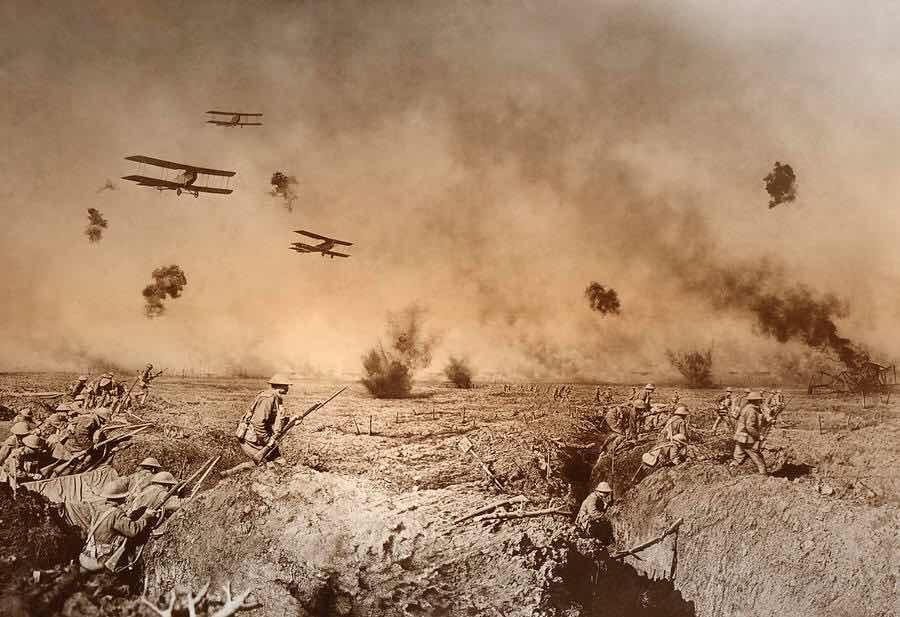
Anthem For Doomed Youth


Anthem For Doomed Youth
by Wilfred Owen, 1917


What passing-bells for these who die as cattle?
      — Only the monstrous anger of the guns.
      Only the stuttering rifles' rapid rattle
Can patter out their hasty orisons.
No mockeries now for them; no prayers nor bells; 
      Nor any voice of mourning save the choirs,—
The shrill, demented choirs of wailing shells;
      And bugles calling for them from sad shires.

What candles may be held to speed them all?
      Not in the hands of boys, but in their eyes
Shall shine the holy glimmers of goodbyes.
      The pallor of girls' brows shall be their pall;
Their flowers the tenderness of patient minds,
And each slow dusk a drawing-down of blinds.

Monday, 11 April 2022

... the clocks were striking thirteen.


"It was a bright cold day in April, and the clocks were striking thirteen. Winston Smith, his chin nuzzled into his breast in an effort to escape the vile wind, slipped quickly through the glass doors of Victory Mansions, though not quickly enough to prevent a swirl of gritty dust from entering along with him.

The hallway smelt of boiled cabbage and old rag mats. At one end of it a coloured poster, too large for indoor display, had been tacked to the wall. It depicted simply an enormous face, more than a metre wide: the face of a man of about forty-five, with a heavy black moustache and ruggedly handsome features. Winston made for the stairs. It was no use trying the lift. Even at the best of times it was seldom working, and at present the electric current was cut off during daylight hours. It was part of the economy drive in preparation for HateWeek. The flat was seven flights up, and Winston, who was thirty-nine and had a varicose ulcer above his right ankle, went slowly, resting several times on the way. On each landing, opposite the lift shaft, the poster with the enormous face gazed from the wall. It was one of those pictures which are so contrived that the eyes follow you about when you move. BIG BROTHER IS WATCHING YOU, the caption beneath it ran...."

These are the chilling opening lines of George Orwell's 1984.


Friday, 28 January 2022

O Canada


Canada. Our Home and Native Land.
The True North, Strong and free.
Proud in Spirit, Strong of Heart.
Not divided in two, but United As One.

Monday, 24 January 2022

Bad Cat Bob

Cartoon detail by Bob Moran, www.bobmoran.co.uk

OK, so who is this bad cat Bob?
Ah, here we go, found him on my go-to Twitter, Wikipedia, Fact Checkers (Facebook), Full Fact, Guardian, BBC, CBC, CNN, Vaxopedia ...
Here he is, Bob Malone, Bob Moran, Bobby Kennedy; why are all these nutters named Bob? Just as I thought: nutbar, conspiracy theorist, anti-vaxxer, dissident, debunked, anti-science, extremist. And I thought Bob was a brilliant cartoonist, epidemiologist, author, speaker, orator, lawyer? More fool, me. Can't be bothered to dig any further; anyway, the evidence is clear. Coach Fauci was right all along. In classic American football style, he is our trusted blustering bully destroying the opposition. He has run up an almost unassailable half-time lead. Trademark defense, running interference, block tackles aplenty, warp speed offense, nullifying the pitiful counter. What a Playbook! Shock and awe! A blowout! He's running up the score, stacking the numbers.

(And yet the home fans never gave up hope. They resisted the onslaught and rallied their brow-beaten troops from meek surrender to valiant fightback, clawing back the deficit despite all the odds. The resilient crowd found its voice and was roused into raucous uplift. It ain't over until the Coach crumbles, his Playbook implodes, or the fat lady sings).

"Science is the belief in the fallibility of experts”, said the brilliant physicist Richard Feynman. 


Friday, 19 March 2021

The Elephant In The Room


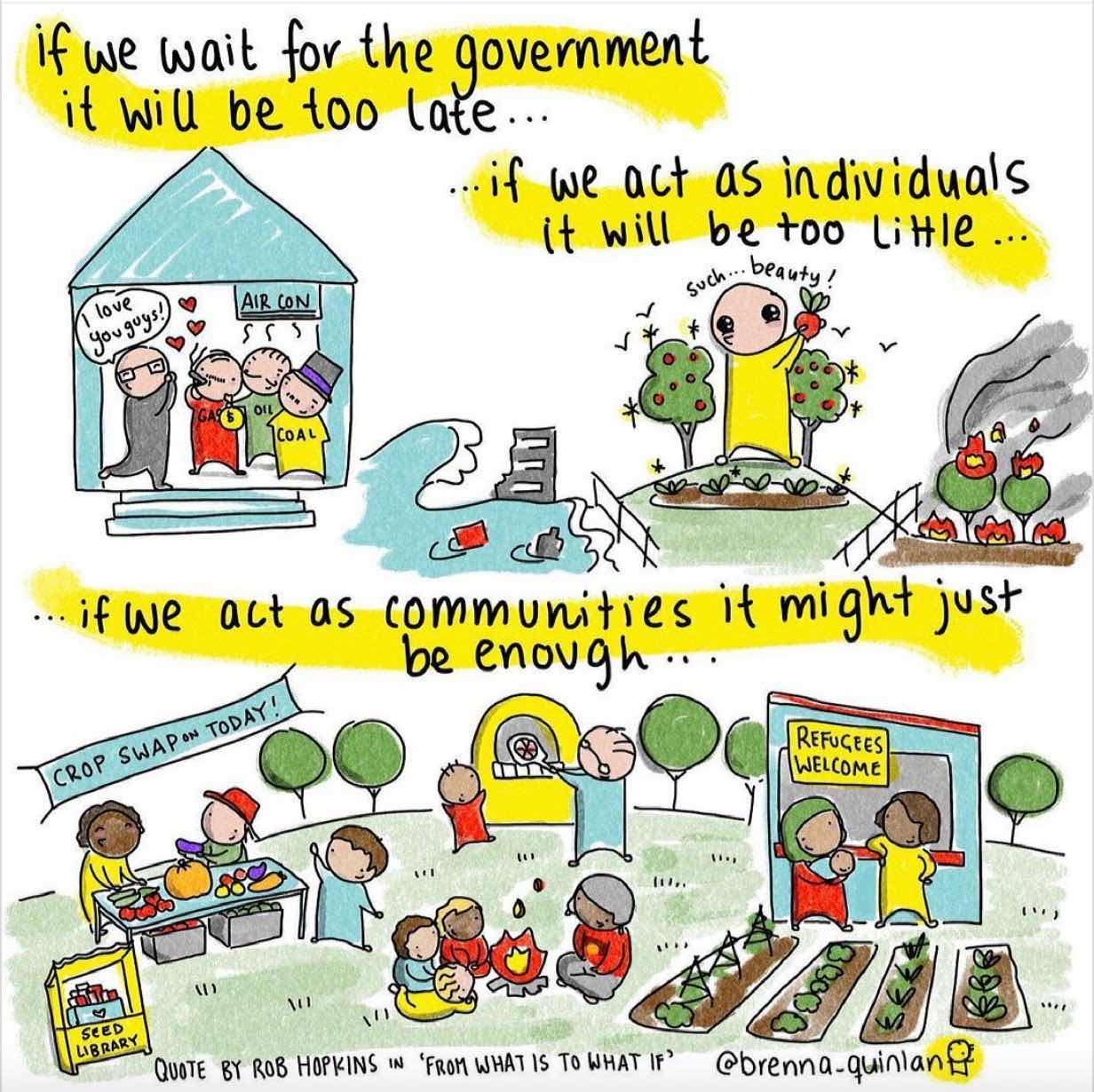
The cartoon depicts the choices available to us if we are to act proactively on mitigating and adapting to climate change - the elephant in the room.
If we wait for the government, it will be too late...
if we act as individuals, it will be too little...
if we act as communities, it may be just enough.

In truth, we need all three approaches, full-on.

Waiting for the government.
In fairness to governments, a lot of heavy-lifting has been done already and the foundational plans are in place. In 2021, after all, we are heading into COP26 in Glasgow, hosted by the 'United Kingdom'.
For over twenty five years the United Nations (of the world) have recognized climate change as a problem and met, moreorless annually, to discuss how to tackle it through these 'Conferences of Parties'. Some have become notorious, like Kyoto, and more recently Copenhagen and Paris, firstly for their grand vision, then for internecine squabbling leading to watered-down resolutions, greenwashing, and foot-dragging. Most of this is on the part of the more developed nations who are causing most of the problem and have more concessions to make, leaving the developing nations screaming for help and being left to sink or swim. Is this top-down approach paying dividends? Not really, as some nations meet their commitments handily (like Germany), slip-slide on their commitments (like tar sands-spewing, pipeline-building Canada), or depart the convention in a huff (the United States). Nations called on to act decisively and bravely are not fully invested in the process. However, noble goals like net zero carbon emissions by 2050, electric cars only and no diesel by 2025 or 2030, fossil fuel divestments now are laudable and absolutely worth clinging on to. Cost of solar, wind, tidal, geo-thermal power in all sectors (commercial, community, and personal) are coming down fast, if not fast enough. Nuclear costs are out of control and this form of risky expensive energy should be abandoned, in my view.

Acting as individuals. 
This is the approach dear to my heart. Gundi and I have both been independently (self) employed since we got married some thirty eight years ago. While this has meant we have to live fairly frugally and have only basic incomes and pensions for our senior years, we have embraced this and want for little. Twenty two years ago we purchased a farm on fifty five acres. We planted 4,000 native trees in a government-subsidized initiative intent on planting 50 million trees across Ontario. We ran a certified organic farm, Rolling Hills Organics, for twenty years and I sold the produce on over four hundred farmers market days. I found that I loved the organic food and farming movement and the sociability of talking to, and selling to, like-minded people. I sat on the board of a Farmers Co-operative made up of thirteen local organic farms all with the same vision of providing local food in a sustainable way. Unfortunately, with competing individual interests, we only sustained it for a few years, but still used it as a platform to expand and reach new markets. I even got to write a book, High Up in the Rolling Hills, focusing on this busy and fruitful time in my life, stressing the need to think seriously about local and global food and farming systems and their long-term viability. Twice we applied for a government-subsidized rooftop solar panel array in Ontario and twice we were turned down by the centralized electricity grid. Here In Cape Breton, we applied for government subsidized rooftop solar once more, making a security deposit, only to be disappointed when the Nova Scotia government lowered the incentive overnight, even before we could be turned down again by the power company for our being too rural and their 'experiencing infrastructure constraints'. We bailed. In this case, government and individuals did not make happy bed-fellows, and besides, the amortization period of 7 - 12 years is too much for old fogies like us!
Having sold the farm, we downsized by purchasing here on the east coast of Canada, not being able to afford astronomical real-estate prices out west where Gundi's daughters and their families live.  I have now set up a micro business procuring wild foods, making locally-sourced food products and selling them through the Cape Breton Food Hub, where I also volunteer weekly. I feel proud to be walking the walk. However, there is always more to be done. We still drive a conventional combustion-engine car and love our Volkswagen Tiguan but drive only 20% of the miles we used to in Ontario with the twice-weekly drives into the city. Twenty years ago we went from two cars to one, even for business too. This required rationalization and planning of each of our schedules but was not really a hardship. Living rurally, we do not have access to public transit. Once the government subsidizes electric or even hybrid cars, as they should, and prices come down, we will happily transition. We purchase local food direct from farms and through the Food Hub but find choices thin and seasonally absent, so we depend on our Atlantic Superstore supermarket for imported fruit, vegetables, coffee, tea, wine. We buy almost exclusively organic, fair trade and non-GMO. Beer is local!

Acting as communities.
In Ontario and Nova Scotia, I have been an active member of the local food and farming movement.We joined the WeAreTheArk community be registering our Oceanside Wild property as an Ark.
www.wearetheark.org writes "An Ark is a restored, native ecosystem, a local, small, medium or large rewilding project. It’s a thriving patch of native plants and creatures that have been allowed and supported to re-establish in the earths intelligent, successional process of natural restoration. Over time this becomes a pantry and a habitat for our pollinators and wild creatures who are in desperate need of support.
This takes time to happen but it begins to re-establish itself as a simple ecosystem very quickly and over time it becomes a strong wildlife habitat and eventually a multi-tiered complex community of native plants, creatures and micro-organisms."
 I support the fresh-bloodied new Liberal premier of this province (aged thirty eight!!) who talks the talk on climate and renewable energies. I also support the local Ecology Action Centre and Extinction Rebellion but am too cowardly, and lazy, to be an active protester. Greenpeace, The Green Party, The Green New Deal? ... Sure, bring on the Green. And Happy St. Patrick's Day. Well done Paddy for driving the snakes away. I have written previously about cities and communites that are talking the talk and walking the walk. Kudos to 350.org, David Suzuki, the Sunrise Movement, the Solutions Project.... 
Way back as a teenager in school my big sister Jill gifted me a seminal book, Small Is Beautiful, by E.F. Schumacher. My dear old Mum worked briefly for him In Oxford at around the time she was helping to write up the Beveridge Report. Small Is Beautiful espouses intermediate technology. While some of its precepts may be dated, the book remains very meaningful to ecologically-minded readers like me. It strikes the right balance. Paul Kingsnorth? I used to revile him for his dark vision and put-downs of the well-meaning environment movement, but I now see that he has some very profound (and prophetic) insights. However, he has apparently just found Jesus....

On that note, I continue looking for saviours, but believe in my heart that only dedicated personal commitments can lead to community resilience and only that can lead to a critical mass and societal change. We will wait too long for our governments to effect the global drawdown necessary. With their dinosaur corporate backers, they are stuck in an antiquated paradigm. Biden and Kerry are, in all likelihoods, but their messengers. 


www.wearetheark.orgwww.wearetheark.org

Monday, 8 March 2021

White Knights & White Elephants

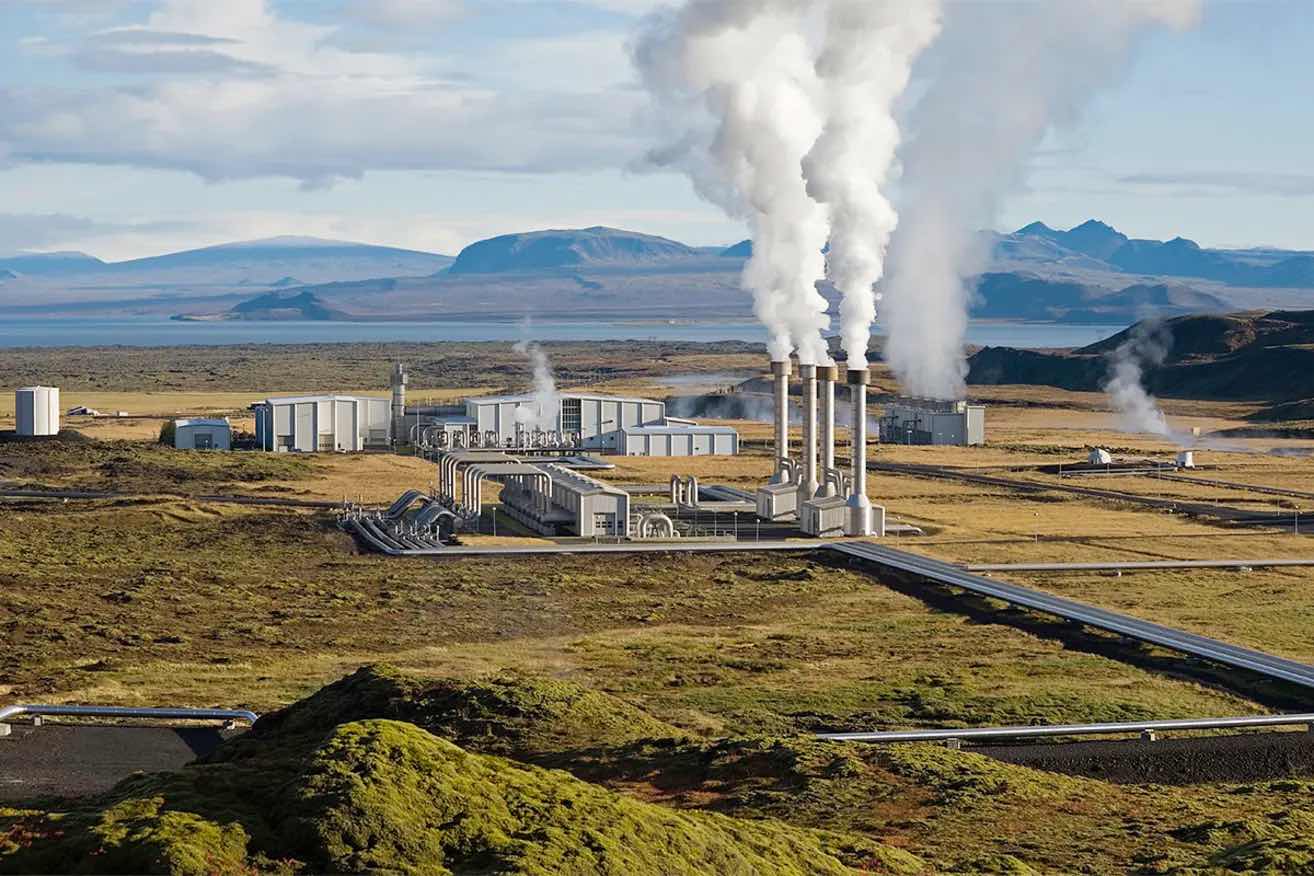
The Nesjavellir Geothermal Power Station (NGPS) is the second largest geothermal power station in Iceland, located near Thingvellir and the Hengill Volcano

So, Can We Cool The Planet? This was the question posed by NOVAs documentary.
The synopsis reveals the following methodologies:
Geo-engineering to reflect sunlight,
sucking CO2 out of the air using industrial fans (a Canadian technology developed in Squamish, BC),
turning CO2 into stone,
creating liquid carbon fuels out of sunlight and air,
recycling atmospheric CO2 to reduce the carbon footprint of concrete, 
enlisting plants and forests to capture carbon. (Now that does make sense, as Nature has been doing that to enable life on Earth well before humanity started trashing the Planet. Ramp up? By all means, but that is not a new technology).
As the synopsis notes, even if all these white elephants ridden by white knights could be accelerated to fit the urgent timelines, they can offset only a fraction of global emissions. We need global action at small, intermediate, industrial and mega scales and we need results, yesterday, now, and definitely down the road. Fortunately, there are people and groups, cities and communities have dedicated hard work, resilience and innovation to these issues for many years already, and progress is being made, if to no great extent in the political arena of national governments and fossil-fuel corporations, then in the groundswell of public opinion and engagement. We recycle, re-purpose, restore, cut waste, consume less, conserve more, but we can't do it quick enough without structural transformation and shocks to the system. It comes back to political will.

"Will tech solve the climate crisis - or make it worse?"
This timely article appeared in The Guardian this weekend:

"Elizabeth Kolbert’s favourite movie is the end-of-the-world comedy Dr Strangelove or: How I Learned to Stop Worrying and Love the Bomb. For those who need a quick recap, this cold war film features a deranged US air force general who orders a nuclear attack on the Soviet Union using weapons developed by a mad Nazi scientist played by Peter Sellers. A last-minute glitch almost forestalls an apocalyptic war, but a gung-ho B-52 pilot has other ideas. He opens the bomb doors and mounts the H-bomb as if it were a horse, waving his hat and whooping as he rides the missile towards the world’s oblivion. No heroism could be more misguided. No movie could end with a blunter message: how on Earth can we humans trust ourselves with planet-altering technology?"
We watched Dr. Strangelove recently. While the special effects are ludicrously out-dated, the plot is poignant yet hilarious and Peter Sellers maniacally brilliant.
Kolbert says: "I am trying to turn something of that Strangelove sensibility on this grave and depressing problem. I want to make people think but in a way that is not unrelentingly grim. Whether to laugh or cry has always been a fine line.”
"As one pithy Danish interlocutor puts it: “Pissing in your pants will only keep you warm for so long.” Soon humanity will need another fix that will likely create another problem."

I read Elizabeth Kolbert's previous book "The Sixth Extinction" a couple of years back. I found it to be well-researched and more than a little scary. My own stance is somewhere between journalist Kolbert's and that of climate researcher Michael Mann, who writes: "Geoengineering appeals to free-market conservatives, as it plays to the notion that market-driven technological innovation can solve any problems without governmental intervention or regulation. A price on carbon, or incentives for renewable energy? Too difficult and risky. Engaging in a massive, uncontrolled experiment in a desperate effort to somehow offset the effects of global warming? Perfect!”.

Much has been achieved already. Countless projects are in development and planned.
Mark Z. Jacobson leads www.thesolutionsproject.orgA stellar Stanford University professor like Leavitt and Ioannidis, Jacobson has presented highly-detailed transitional energy roadmaps for 143 countries, 50 U.S. states, 74 metropolitan areas, 30 mega-cities, and 53 cities and towns to convert to 100% renewable energies:


"We're an international movement of ordinary people working to end the age of fossil fuels and build a world of community-led renewable energy for all.
Here's how we get there:
1. A fast & just transition to 100% renewable energy for all
Accelerate the transition to a new, just clean energy economy by supporting community-led energy solutions
2. No new fossil fuel projects anywhere
Stop and ban all oil, coal and gas projects from being built through local resolutions and community resistance.
3. Not a penny more for dirty energy
Cut off the social license and financing for fossil fuel companies — divest, desponsor and defund.

Their plan for the next 10 years:

"The change to a renewable world is inevitable – and the beginning steps pose the greatest challenge. A world so overwhelmingly dependent on fossil fuels requires bold ideas, dramatic shifts in thinking, and action without delay. Fortunately we can find examples of this change across the world, at all levels of personal and collective engagement. This collection aims to portray a series of pioneering initiatives and their champions."
This website has scads of examples (described by country/island, region/state/district, city/town/village) along with target achieved/works in progress of existing initiatives around the world. These are projects that have the research and planning done and shovels in the ground. There are amazing initiatives everywhere. Especially innovative and effective are those cities with visionary leaders like Barcelona, Paris, Copenhagen, San Francisco, Berlin.

And just take a look at these:

We need to continue to use regenerative agriculture, permaculture, organic farming, soil carbon sequestration, reforestation, conservation, waste management with increased vigour and urgency. Good old boy Joe Biden is stuck in the old paradigm of industrial chemical agriculture with his choice of corporate crony Tom Vilsack as  his Secretary of Agriculture. The bold Green New Deal will not be ratified under his watch. No need to wait for white knight Bill Gates to catch up or Jeff Bezos and Mark Zuckerberg to wake up. No need to suck air out of the place or to divert life-giving sunlight with their white elephants, either. Unintended consequences, anyone? With their obscene wealth, why can't these men leave a truly meaningful legacy? Brains but no heart, perhaps.